


How to create SKU numbers: a simple format with examples
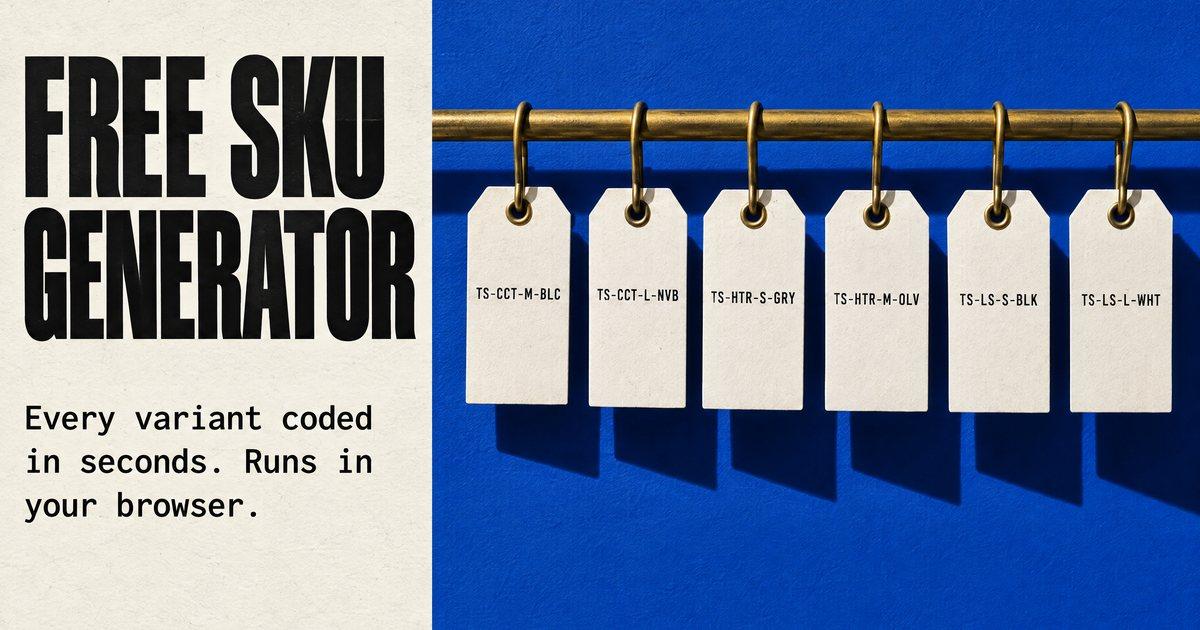
To create a SKU number, build a short code from the things that identify one sellable item: its product type, its name, and its options, in the same order every time. A black Classic Crew Tee in medium becomes TS-CCT-M-BLC. You make the code up yourself, so the only rules are the ones that keep it readable and unique.
If you'd rather skip the typing, our free SKU generator builds codes for every variant, and it runs in your browser with no sign-up.
What a SKU is, and when you need one
A SKU, or stock keeping unit, identifies one sellable item in your own stock. The same shirt in medium and in large gets two SKUs. Nobody assigns it for you, which is how it differs from a barcode.
Shopify lets you leave the SKU field empty. You'll want SKUs once you count stock, work with a warehouse or 3PL, sell on more than one channel, or read sales reports by variant, because the SKU is what ties those records together.
A simple SKU format that works
Build the code from up to five parts, left to right, and use one separator throughout. Start with an optional prefix for your brand or supplier, which you can leave out if you sell one brand. Then add a short code for the product type, so T-Shirt becomes TS.
Next comes the product name. Several words become their initials, so Classic Crew Tee is CCT, and a single word keeps its first letter and its consonants. After that, add one part per option in a fixed order, such as size then color. Short values like XL or 32 stay as they are, and Black becomes BLC.
The last part is an optional running number. It adds 001, 002 and so on, which helps when two variants would otherwise share a code.
SKU examples
Here's the same pattern on one product. A Classic Crew Tee in medium black is TS-CCT-M-BLC, and the same tee in extra large black is TS-CCT-XL-BLC. Anyone on your team can read the difference without opening a spreadsheet.
Codes of about 8 to 12 characters are common. Aim for something short enough to read aloud and type without mistakes.
SKU mistakes to avoid
Start with a letter, because spreadsheets drop leading zeros and turn 0012 into 12. Use letters, numbers and one kind of separator, since spaces and symbols break imports and barcode labels.
Leave price, season and stock level out of the code. They change, and the SKU shouldn't. And never reuse a SKU, even for a product you've stopped selling, because old orders and reports still point to it.
How to add SKUs to a whole Shopify catalog
Export your products from Shopify as a CSV and open it in our free SKU generator. It fills the empty SKUs, keeps the ones you already have, and treats your existing codes as taken so a new one never duplicates them. Import the file back into Shopify and you're done. Your file is read on your own computer and never uploaded.
On WooCommerce or another platform, generate the codes for one product at a time, up to three options per product, and download them as a CSV to paste in.
Clean product data helps you sell
Tidy variants pay off in front of shoppers too. Agentmatica, our sales and support agent, reads your live catalog on Shopify and WooCommerce. When a shopper asks for the black tee in medium, it shows the product as a card, adds that variant to the cart and hands over a checkout link.
Questions store owners ask
How do you create a SKU number?
Combine short codes for the product type, the product name and each option, in the same order every time, with one separator. A medium black Classic Crew Tee could be TS-CCT-M-BLC. Our free SKU generator builds these for every variant.
Is there a free SKU generator?
Yes. Agentmatica's SKU generator is free, needs no sign-up, and runs in your browser. It creates SKUs for every combination of up to three options, and fills the empty SKUs in a Shopify product export.
How long should a SKU be?
Short enough to read aloud and type without mistakes. Codes of about 8 to 12 characters are common.
What's the difference between a SKU and a barcode?
You create a SKU yourself to identify an item in your own stock, so you can build it from whatever matters to your store. Nobody else assigns it.
Put your catalog to work
Agentmatica answers shopper questions from your pages and catalog, recommends what fits and builds the cart on Shopify and WooCommerce. Start free with no card.
Try it free